
Kakadu National Park
I was once told that Australia's land mass is actually levelling out, and that eventually the country would reach a stage of flatness when the country would look like a moonscape.
So long as there's still beer in the 'fridge I doubt whether anyone in Darwin would notice. The Northern Territory (NT) is home to two truly great things: the NT attitude ('Not Today, Not Tomorrow...'), and Kakadu National Park.
I knew little about the Park when I was offered a job there, apart from the fact that it's where Crocodile Dundee was filmed. Over the next couple of months, though, I learned a fair amount about one of the most stunning and awe-inspiring parts of Australia.
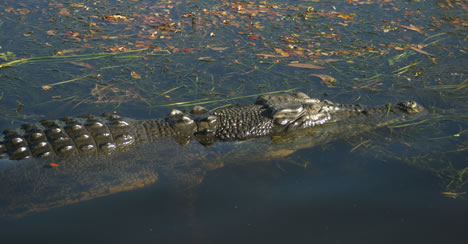
Most people visiting the Park do so as part of an organised tour from Darwin, generally three days long. Bouncing around in a chunky four wheel drive, you get the chance to see your fair share of snakes, Jabiru- birds, gekkos and crocodiles, if you're lucky.
(Or unlucky, depending upon the circumstances. Every now and again the newspapers
would carry a story about some local who decided to take a short cut by swimming
across the river and ended up croc-food. Even the resort where I worked had
rumours of a beast lurking in the long
grass next to the billabong, just waiting for the next tourist-sized meal. As
far as I was concerned, this was divine justice, since most of those tourists
had grown temptingly fat by gorging on croc-steaks in the resorts restaurant).
The highlight of the trip for most though is the waterfalls. Massive geological action has pushed up a ridge running North/South through the middle of the Park. The water flows underground from the centre of the country, eventually merging into streams, then brooks, then rivers, before beginning it's pounding descent over the escarpment. After falling two hundred feet, the water regroups and continues it's long journey to the flatlands and swamps of the coast.
Kakadu is the only national park in the world to follow a watercourse from beginning to end in this way, and it's one of the things which has earned it its status as a World Heritage Area. Tourism is a relative newcomer to the Park though. The original reason for it's inhabitation by white folks was the presence of some 20% of the world's uranium beneath the scorched red soil.
The discrepancy between the Park's status as a World Heritage area and the existence of large scale mining of hazardous substances seems to go unmarked, perhaps due to the $10 million per year the mines yield for the Gagadju Association, the Park's true owners.
As I started work, though, protests were beginning over the opening of a new mine in the Park. Ardent eco-warriors had set up tressle tables outside the mines entrance and were collecting signatures for a petition. It all seemed rather bleak, not helped by the drone of helicopters, ferrying workers into the mine over the heads of the protestors.
Whilst the aborigines discerned six seasons in the cycle of life in Kakadu,
modern settlers have simplified this to just two: Wet
(December to March) and Dry (June to August).
Leading up to the Wet is the Build Up, when massive clouds roll in, disgorging
sheets of rain. Within minutes the place is awash and
guttering is overwhelmed. Then just as quickly as they came, the clouds roll
away, spent, into the distance. The sun mops up the land and the pressure returns.
More travel stories
Highly recommended tour companies

Support local communities and protect the environment

Exciting and responsible overland and adventure tours

Superb group adventure tours and exciting short breaks