
Exploring Havana, Cuba
Havana's reputation as a tourist destination seems to increase daily. The city's music has spread like wildfire, helping to give Cuba it's deserved status as a 'very cool place indeed'.
Centro Habana contains most of the city's must-sees, chief amongst which is The Kapitolio, a grandiose Greco-roman palace which housed the pre-Castro government, and has somehow managed to clear a space for itself amongst the detritus of Havana.
The entrance is framed by two statues of the kind of Greek guys who have a wardrobe full of togas and slay a lion before breakfast. Needless to say, this European decadence did not sit well with La Revolucion. The building just didn't have enough concrete to be communist, and the exquisite filigree would have played hell with the murals. Today the hallways are empty of everything except tourists.
To say that Cuba is one of perhaps three major communist powers surviving today gives a wrong impression, especially in the tourist traps, where dollar currency is the only currency. (As I tried to pay using pesos, the shopkeeper pointed at the depiction of Ernesto Guevara, and said, 'Che, no good').
The Revolution seems to survive in the same way that Christianity lives on in Britain. It's values still inform society, and the pictures of it's heroes still tug at the heart-strings. But the needs of every day life in this crumbling country continue apace, regardless of the ideology.
Where communism has made a difference is in providing a minimum standard of living for Cubans, and in isolating the country so effectively from the United States, preventing its transformation into the resort wonderland of Jamaica, just a couple of hundred kilometres away.
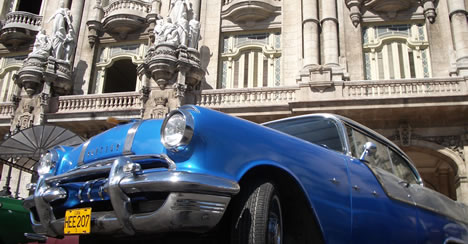
The lack of investment has served to keep Havana almost in a timewarp, where '67 Chevvies (whatever that means) cruise between crumbling colonial facades. For anyone interested in architecture, Centro Habana is a goldmine. Paint peels off wrought iron balustrades, weeds grow around the shutters of elegant French windows, and in a single street you find Middle Eastern stucco, modernism straight from the 20's, Moorish doorways, Moroccan tiling and Stalinesque edifices.
Literally thousands of building fall over every year here, simply through lack of funding to keep them up. The irony is, though, that if the money was here to renovate these faded gems, it would be used to knock them all down and build a hi-rise haven. Cuba's poverty is its only protection against becoming another Caracas or Jakarta.
Hiring a car allows you to see a different side to Cuba. Farms full of cattle drift by, and ancient rancheros wear gumboots and straw Stetsons, striding purposefully holding machetes through fields of sugar cane as the sun burns character into their faces.
Sugar is a major part of Cuban life, and keeps the doddering economy on its feet. Christ knows who it was who had so much of the stuff he decided to make a drink out of it, but it's him we have to thank for Cuba's obsession with rum-based cocktails. There are few better places to enjoy slurping on a Mary Pickford (don't worry, Mary Pickford is a drink) than Vinales, a beautiful area of mountains and farms 150 km. West of Havana.
The region is riddled with caves, and after one too many cocktails the previous night, it's good to be somewhere dark and cool.
Heading North we arrived at Villa El Salada (possibly translated as 'Village of Salad'). The place looked like a 1950's Butlin's camp given a make-over by Joe Stalin. As we entered the bar, the staff instantly clocked the arrival of a pair of gringos, and the salsa music gave way to a tape of Roxette's Greatest Hits, if that's not a contradiction in terms.
I had an interesting conversation about The Beatles with the guy who cleaned the pool, which consisted of me naming members of the band and him performing the actions of the instruments they played. After an hour, I became bored and threw in Yoko Ono as an experiment. A look of hostile fear entered his eyes. It was time to check out.
We returned to Havana on my birthday, and consequently the reportage becomes sketchy. The only useful fact I can recall is that Cuban beer is called 'Cristal', and seems to be readily available, irrespective of whether you're able to stand upright or not.
As a post-script, it's always nice to arrive back in the U.K., if only to allay my paranoid fear that, having got rid of me, British immigration will seize its chance and refuse to let me back in.
More travel stories
Highly recommended tour companies

Support local communities and protect the environment

Exciting and responsible overland and adventure tours

Superb group adventure tours and exciting short breaks